

Nigeria Should Recognise Stablecoins as Export Proceeds


An opportunity to improve export competitiveness, deepen foreign-exchange liquidity and make the Naira more accessible to international markets.
There is an interesting detail in the Central Bank of Nigeria's Export Proceeds Form (NXP). Alongside information about the goods being exported, their destination and their value, the form includes fields for the mode of payment and currency. It is a fairly straightforward document, built around an equally straightforward principle: when Nigerian businesses sell goods abroad, the proceeds should find their way back into the Nigerian financial system.
The principle remains important, but the infrastructure through which international payments move has changed considerably. Today, a business exporting cocoa to Europe, textiles to the United States or manufactured goods to another African country can receive payment through a dollar-backed stablecoin within minutes. The transaction can be recorded on a public blockchain, verified independently and converted into other forms of money through a regulated exchange.
Nigeria's export-proceeds framework has not yet caught up with this development. Under existing regulations, exporters are required to repatriate their earnings through authorised banking channels, with non-oil exporters generally given 180 days to do so. Stablecoins, despite their growing role in cross-border commerce, are not recognised as a standalone means of satisfying these requirements.
I believe there is a significant opportunity for the CBN to establish a framework that recognises approved stablecoins as acceptable instruments for receiving and settling export proceeds. This would improve payment efficiency for Nigerian exporters, create more flexible ways to meet their international obligations and potentially expand the role of the Naira in global digital financial markets.
International trade is increasingly moving onchain
Nigeria's export ambitions have traditionally focused on increasing production, improving quality and expanding access to foreign markets. These are necessary priorities, but the competitiveness of an exporter also depends on how efficiently it can receive payment and deploy those earnings.
Consider a Nigerian manufacturer that exports processed agricultural products but imports specialised machinery, packaging materials and other production inputs. The business earns foreign currency from its customers and must periodically use that same currency to pay suppliers overseas. Traditionally, this involves receiving foreign earnings through banks, managing international payment arrangements and navigating the costs and delays associated with multiple financial intermediaries.
Increasingly, however, foreign suppliers are willing to accept payments in dollar-backed stablecoins. Whether purchasing equipment, paying an international logistics provider or sourcing manufacturing inputs, businesses are encountering a growing network of counterparties that can receive digital dollars directly.
This changes the economics of the exporter's cash cycle. An exporter receiving payment in USDT or USDC could, under an appropriate regulatory framework, use part of those proceeds to settle eligible foreign-currency obligations in the same instrument. Instead of repeatedly converting between digital dollars, conventional foreign currency and back again, the business could retain its earnings in the form required for its next international payment.
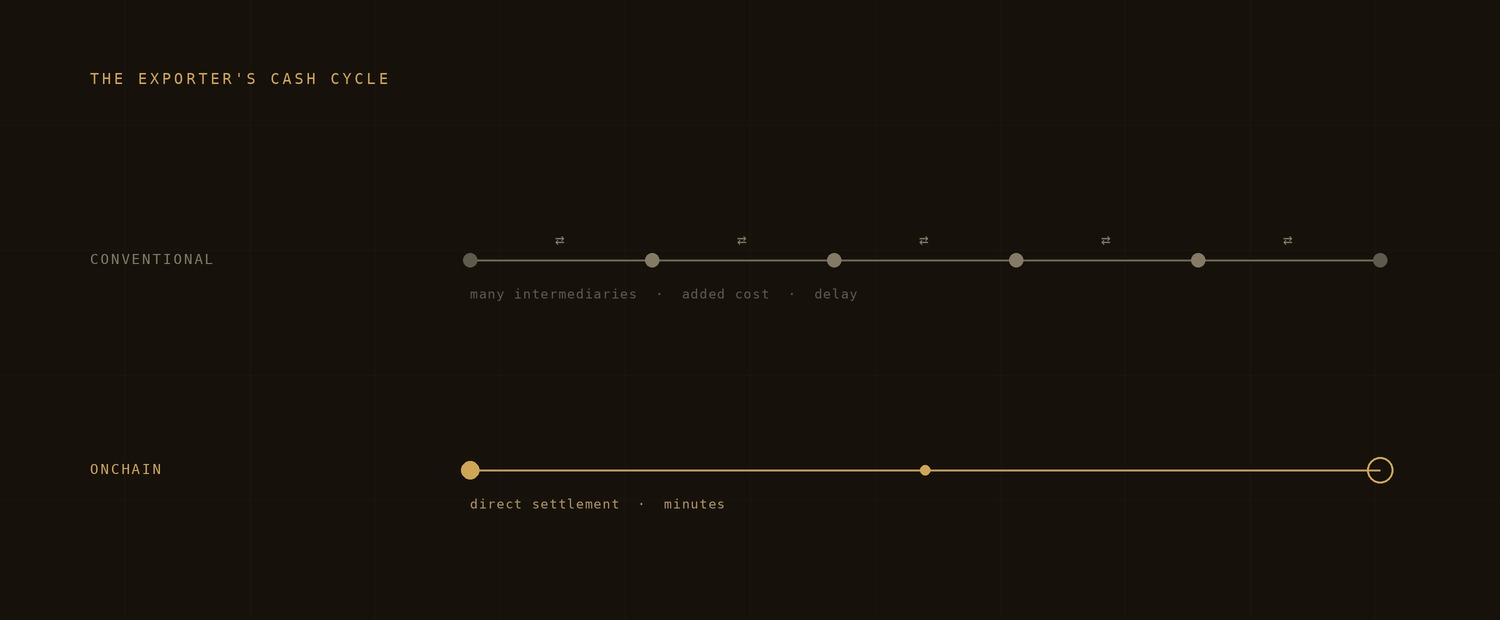
The advantages extend beyond transaction speed. Every additional conversion or intermediary can introduce costs, settlement risk and administrative complexity. For exporters operating on relatively thin margins, particularly in agricultural processing and manufacturing, these frictions have a direct bearing on competitiveness. A framework that allows approved stablecoin receipts to be applied to documented foreign trade obligations could help reduce them considerably.
This is not an argument for allowing exporters to keep earnings offshore without oversight. Such transactions would need to be recognised, documented and reconciled under a revised export-proceeds regime. But there is an important distinction between ensuring that export earnings are properly accounted for and requiring every legitimate foreign-currency obligation to pass through a particular payment infrastructure.
A more efficient market for converting export earnings
The second opportunity concerns what happens when exporters need to convert their foreign earnings into Naira.
Many Nigerian exporters have substantial domestic obligations. They need to pay employees, purchase local raw materials, finance production, pay taxes and settle suppliers. Even when their earnings are denominated in dollars, a significant portion ultimately needs to be converted into Naira.
The traditional foreign-exchange process can be cumbersome. Exporters do not always have immediate access to competitive liquidity at the point they need to convert. Depending on their banking arrangements and transaction size, some find themselves looking for buyers for their foreign currency, negotiating rates or waiting for transactions to be completed. The process can become an additional treasury management burden for businesses whose primary occupation should be producing and exporting goods.
Regulated digital asset exchanges offer a different market structure. An exporter receiving dollar-backed stablecoins could sell them for Naira through an exchange with available liquidity, using transparent market prices and automated order matching. Rather than independently searching for a counterparty, the exporter accesses an existing pool of buyers and sellers, with digital asset settlement potentially completed almost immediately.
The same infrastructure could support conversion into a Naira-backed stablecoin such as NGNb, allowing businesses to retain value in Naira while benefiting from the transferability and programmability of an onchain settlement asset. Where the exporter needs conventional Naira, payment into a domestic bank account can be facilitated through the exchange's integrated payment infrastructure, subject to the relevant processing requirements.
The practical advantage is a more integrated process for receiving, exchanging and deploying earnings. A business could receive dollar stablecoins, allocate a portion to approved international obligations and convert the balance into Naira or NGNb for domestic use, all through regulated financial service providers.
Of course, this depends on market liquidity, competitive pricing and appropriate regulatory permissions. But it offers a compelling alternative to the fragmented processes many businesses currently navigate. And by introducing more participants and transparent pricing into the foreign-exchange market, such infrastructure could contribute to greater market depth and more efficient price discovery.
NGNb and the opportunity for a more internationally accessible Naira
There is another dimension to this discussion that I find particularly interesting.
At Busha, we are already seeing demand for tokenised Naira from foreign importers who want to purchase goods from Nigeria. These are businesses outside the country that need Naira to transact with Nigerian suppliers, but do not necessarily have convenient access to conventional Nigerian banking infrastructure.
This demand points to an opportunity that extends beyond making it easier for Nigerian businesses to receive dollars. It suggests that there is a market for making the Naira itself more accessible internationally.
Historically, the Naira has had limited availability outside Nigeria. Foreign businesses wishing to acquire the currency generally need to rely on banks, payment intermediaries or local counterparties. Unlike the major international currencies, there are relatively few accessible markets through which non-residents can readily obtain and use Naira for settlement.
Tokenisation introduces another possibility.
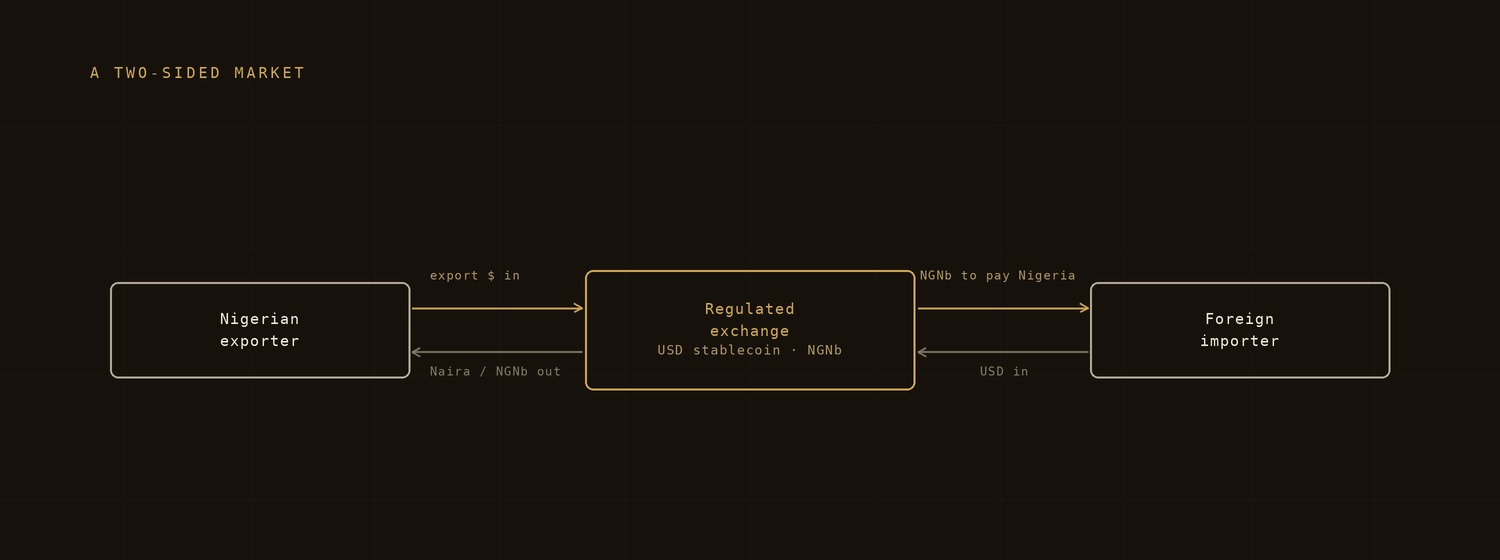
With NGNb, the Naira-backed stablecoin we have introduced at Busha, we are building infrastructure that makes Naira-denominated value available across blockchain networks. An approved foreign participant could acquire NGNb by exchanging dollar stablecoins through a regulated platform, and subsequently use it for eligible Naira-denominated transactions with Nigerian counterparties. The Nigerian recipient could then redeem it for conventional Naira or continue using it within a compatible digital financial ecosystem.
This could be particularly valuable for businesses that regularly purchase goods from Nigeria, as well as financial institutions and payment providers serving cross-border trade corridors. Instead of treating Naira as a currency that can only be conveniently accessed within Nigeria, NGNb creates the possibility of acquiring and transferring Naira-denominated value through the same global infrastructure already used for dollar stablecoins.
In economic terms, this could improve the Naira's effective convertibility at the onchain layer. It would not remove foreign-exchange regulations or eliminate currency risk, but it could substantially reduce the practical barriers to accessing and exchanging Naira. With sufficient liquidity and market participation, the result could be deeper trading markets, more efficient currency conversion and greater international utility for the Naira.
This also connects to my doctoral research on tokenisation, which examined how tokenised financial instruments can influence market accessibility, velocity and price formation. One of the important possibilities with tokenised money is that its usefulness depends not only on the underlying currency, but also on the networks and markets through which it circulates. Making the Naira accessible on shared global settlement infrastructure could expand the number of participants able to transact with it, without changing its underlying monetary characteristics.
There is a complementary relationship here. Nigerian exporters need efficient ways to receive foreign earnings, while foreign importers need efficient ways to acquire the currency used to purchase Nigerian goods. Dollar-backed stablecoins and Naira-backed stablecoins could support both sides of that market, creating new opportunities for regulated exchanges to connect international trade flows with domestic liquidity.
A regulatory framework worth exploring
The CBN has already demonstrated an interest in understanding the opportunities and risks associated with stablecoins. Its second regulatory sandbox cohort includes stablecoin payments, virtual asset exchanges, custody and fiat on- and off-ramp infrastructure, providing a mechanism through which these business models can be tested under regulatory supervision.
Recognising approved stablecoins within the export-proceeds framework would be a natural extension of this work. The CBN could initially establish a controlled programme involving authorised dealer banks, regulated digital asset exchanges and selected exporters, with clear requirements for the stablecoins and settlement providers permitted to participate.
The framework would need to establish how stablecoin receipts are reported against Form NXP declarations, how their foreign-currency value is determined and how the proceeds can be converted or applied to eligible transactions. It should also prescribe the circumstances under which documented payments for imported machinery, production inputs and other legitimate business obligations may be settled directly using approved stablecoins, with appropriate reconciliation against export earnings.
Existing reporting, anti-money-laundering and foreign-exchange controls would remain essential. Blockchain transactions provide useful records, but they cannot independently establish the legitimacy of an underlying commercial transaction. Integrating those records with export declarations, verified counterparties and regulated settlement infrastructure would allow the authorities to retain visibility over the movement and use of export earnings.
The CBN's own 2026 Foreign Exchange Manual already recognises that export proceeds can ultimately be sold in the foreign-exchange market or utilised for eligible transactions, subject to existing repatriation requirements. The proposed reform would extend the range of approved instruments and establish how stablecoin transactions could be treated within that framework.
Such a programme could also generate valuable evidence about the economic impact of stablecoins on trade settlement, foreign-exchange liquidity and the development of domestic currency markets. Rather than regulating the technology in isolation, the CBN would be examining its application to a clearly identifiable economic activity with measurable outcomes.
Bringing Nigerian trade into the next generation of financial infrastructure
Nigeria has an opportunity to approach stablecoins as more than instruments for trading digital assets. Their growing use in international payments creates practical applications for businesses engaged in cross-border commerce, particularly those that routinely earn foreign currency, purchase inputs overseas and maintain significant domestic operating expenses.
For exporters, the attraction is straightforward: receive international payments more efficiently, use those earnings to settle eligible foreign-currency obligations and convert the remainder into Naira through more accessible and liquid markets. For foreign importers, tokenised Naira creates an additional way to access the currency needed to transact with Nigerian businesses.
The opportunity for regulators is to bring these activities within a framework that improves transparency and preserves the integrity of Nigeria's foreign-exchange system, while allowing financial infrastructure to evolve alongside the businesses it serves.
I believe local-currency stablecoins such as NGNb have an important role in this transition, particularly as demand for Naira-denominated settlement develops beyond Nigeria's borders. The larger opportunity, however, is an ecosystem in which international trade, currency exchange and domestic settlement can operate through increasingly connected financial markets.
Nigeria has spent considerable effort encouraging the world to buy more of what we produce. We should give equal consideration to making it easier for the world to pay us, and for Nigerian businesses to put those earnings back to work.